
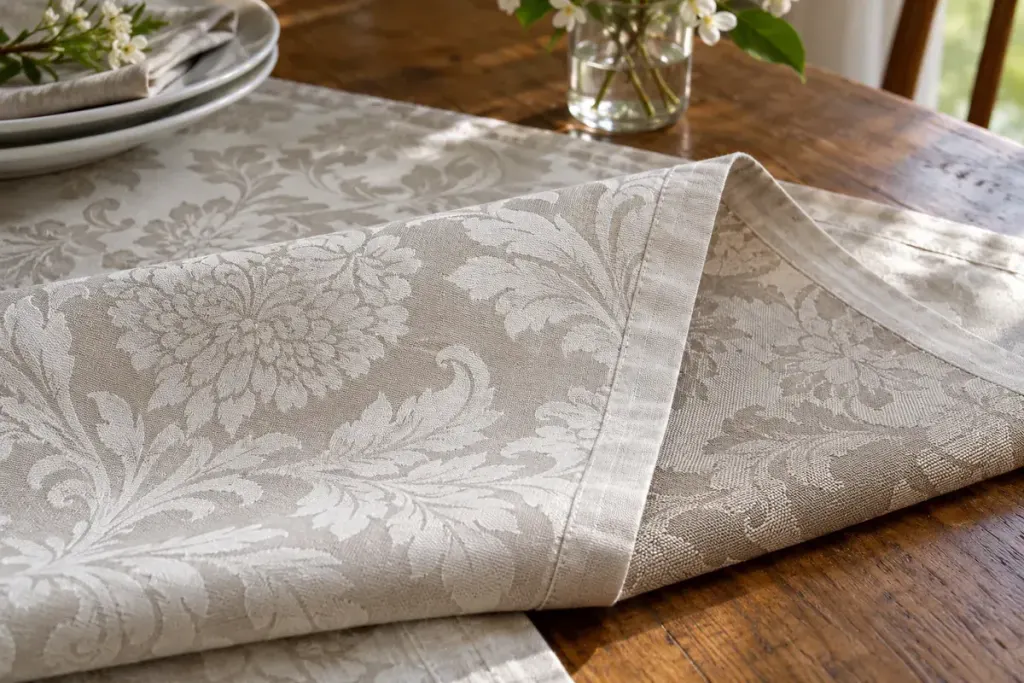
A white tablecloth seems almost plain from one angle. Move it towards the light and a floral pattern appears. In damask, the design is created through the weave, so contrasting surfaces can reveal the pattern without requiring a printed colour.
The Metropolitan Museum of Art’s wool-damask record describes a reversible textile patterned through contrasting warp- and weft-faced areas. The term concerns construction, not a guarantee of one particular fibre.
Turn the sample over
Examine the face and reverse under the same light. Look for the pattern’s relationship to the background and how their appearance exchanges. Then tilt the sample slightly. A sheen difference can become more visible as the direction of light changes.
Do not identify every shiny floral cloth as damask from a photograph alone. Printed, embroidered and other woven designs can look similar at a distance. Ask the supplier how the pattern is made and what the fibre composition is.
Choose for the room and the routine
Imagine using the sample on a dining table beneath a low pendant light. Its pattern may appear more pronounced than it did under the shop’s diffuse lighting. Try a physical swatch where the finished item will be used if the visual effect is important.
Check weight, drape, dimensions and care instructions separately. A damask weave does not tell you whether the cloth tolerates your preferred wash cycle or suits frequent everyday laundering. Fibre, finishing and construction details all contribute to that decision.
For sewing, mark the intended face and orientation before cutting so the finished panels behave consistently in the light. Keep a labelled offcut with the composition and care information. That small reference is useful when matching an additional piece later.
A sample note might read: “Pattern visible in side light; reverse has a different sheen balance; care label requires this wash method.” Those observations support a purchase more directly than calling the fabric luxurious.
Damask rewards close looking. Its interest often lies in how the same threads create a changing relationship between motif and background, so give both sides and the intended lighting a place in the decision.