
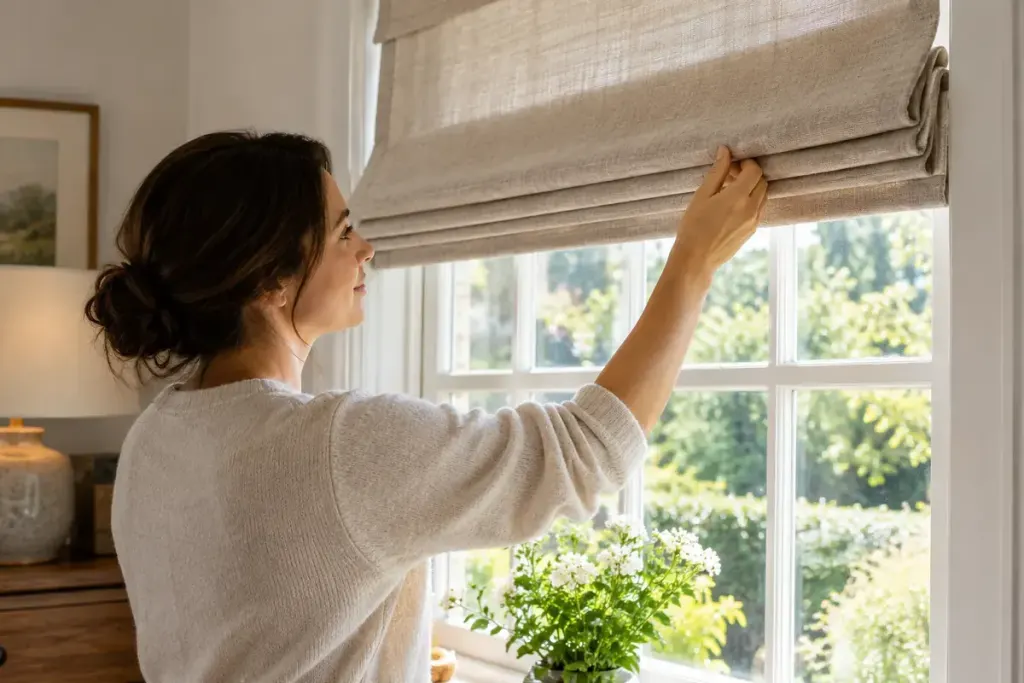
A Roman blind looks beautifully flat in a fabric sample, but when raised it gathers into folds. Those folds form a stack that can cover part of the window even when the blind is fully open.
Blinds.com’s Roman-shade buying guide identifies the tall raised stack as a consideration because it can obstruct the view. The actual stack depends on the product, size, construction and fabric, so use the supplier’s dimensions rather than a generic estimate.
Measure the open view as well as the closed coverage
Decide whether the blind will sit inside the recess or outside it. Then ask how the raised stack relates to the top of the glass. An outside mounting may allow the stack to sit higher, but only if the wall space, fixing surface and product instructions permit it.
Check handles, opening sashes and nearby fittings. A blind that fits the window width can still interfere with opening or cleaning. The headrail depth and operating mechanism need space too.
For a dark room, the amount of glass covered when the blind is raised may matter as much as the fabric’s colour. Draw the proposed stack position on a photograph or a simple elevation before ordering.
Ask for the dimension you actually need
Give the supplier the intended finished blind size and ask for the raised stack height for that exact configuration. Clarify whether the quoted figure includes the headrail. If several fabric or lining options are being compared, check whether they alter the result.
Choose an operating system that meets applicable child-safety requirements and follow the installation instructions. Do not improvise cord arrangements to make an unsuitable mounting position work.
A useful order note includes recess dimensions, mounting position, obstructions and expected visible glass when raised. This makes the choice easier to assess than a fabric swatch alone. A Roman blind should work in both of its main states: lowered for coverage and raised for light and the view.