
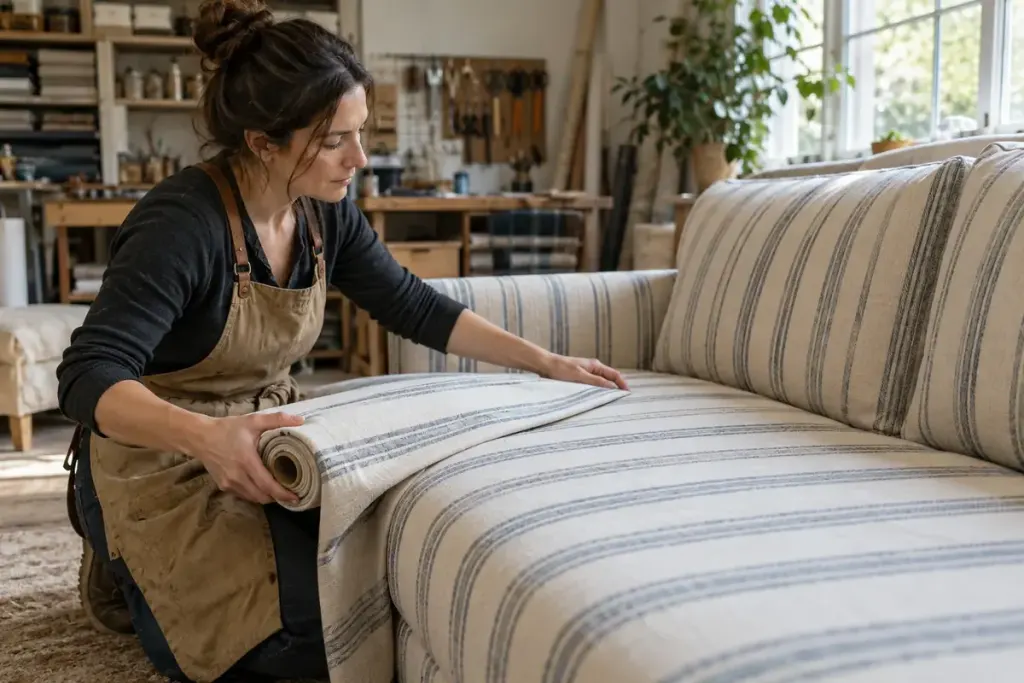
A striped sample looks right in your hand, yet the finished sofa could carry the stripes in an unexpected direction. The missing information may be how the design runs across the fabric roll and how the upholsterer intends to cut it.
Put the roll direction on the sample
Railroaded upholstery fabric is intended to be used with the design oriented across the roll in a way that can suit wide upholstered areas. The term concerns orientation; it does not mean every fabric can be turned through ninety degrees without consequences.
A product example is Sailrite’s Franci fabric listing, which identifies a railroaded stripe. Read the exact product’s specification and obtain a marked sample rather than inferring direction from a cropped online photograph.
Show the whole furniture panel
Ask the upholsterer to sketch the intended pattern direction on the seat, back and arms. A seamless wide panel may be possible in one orientation but not another. Usable width, pattern repeat and the furniture’s dimensions still constrain the cutting plan.
Check whether nap, surface texture or construction limits rotation. Velvet-like surfaces and directional motifs can look different when turned, even if the colour name stays the same. View the sample in the room’s light and in the proposed orientation.
For a practical mock-up, mark the roll edge and an arrow on paper, then place a large pattern outline across it. This helps you discuss direction without cutting expensive cloth. Keep the supplier’s orientation note with the approved upholstery plan.
Do not order yardage from width alone. Allow the professional making the piece to calculate seams, repeats and other requirements. The useful approval is specific: this fabric, in this direction, on these panels. That prevents an attractive small swatch from becoming a surprisingly different full-sized pattern.