
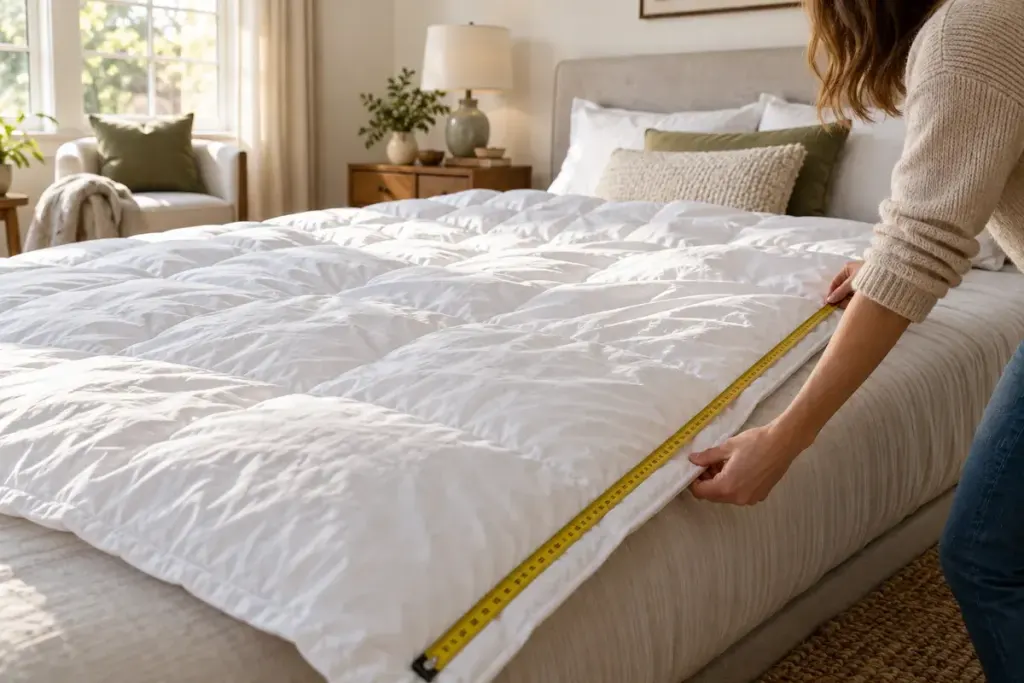
A cover labelled “double” can still fit your duvet poorly. Bed-size names vary between markets and product ranges, so the dimensions in centimetres or inches are a better starting point than the familiar label.
Measure the insert in a relaxed position
Lay the duvet flat without stretching it and measure its length and width. Check the manufacturer’s label too. If the measurement differs from the stated size, consider whether loft, use or previous care affects how you are measuring, and ask the supplier when the difference matters.
Compare those dimensions with the cover’s finished size. Keep length and width in the same order and convert units carefully. A listing that gives only the mattress size has not yet told you the cover’s dimensions.
Look beyond the rectangle
Check the closure, internal ties or other attachment points and whether they correspond to the insert. A cover that is easy to fill and secure may be more practical than one whose decorative details obscure the opening or fastening.
Read the care instructions for both pieces. Do not assume a cover will shrink into the desired fit, or deliberately use unsuitable washing conditions to change its size. Fibre, construction and finishing can affect behaviour, and the product instructions should guide care.
- Save the exact dimensions before shopping.
- Confirm whether the listing is for one cover or a set.
- Check any stated size tolerance and return conditions.
- Inspect the product before washing or removing required return labels.
For an invented comparison, an insert measuring 200 by 220 centimetres should be assessed against the cover’s stated dimensions, not simply matched with another item called “queen.” The name alone cannot resolve the fit.
Keep a small bedding record for each room: insert dimensions, preferred cover size and care requirements. That turns the next purchase into a straightforward comparison instead of another guess based on a naming convention.