
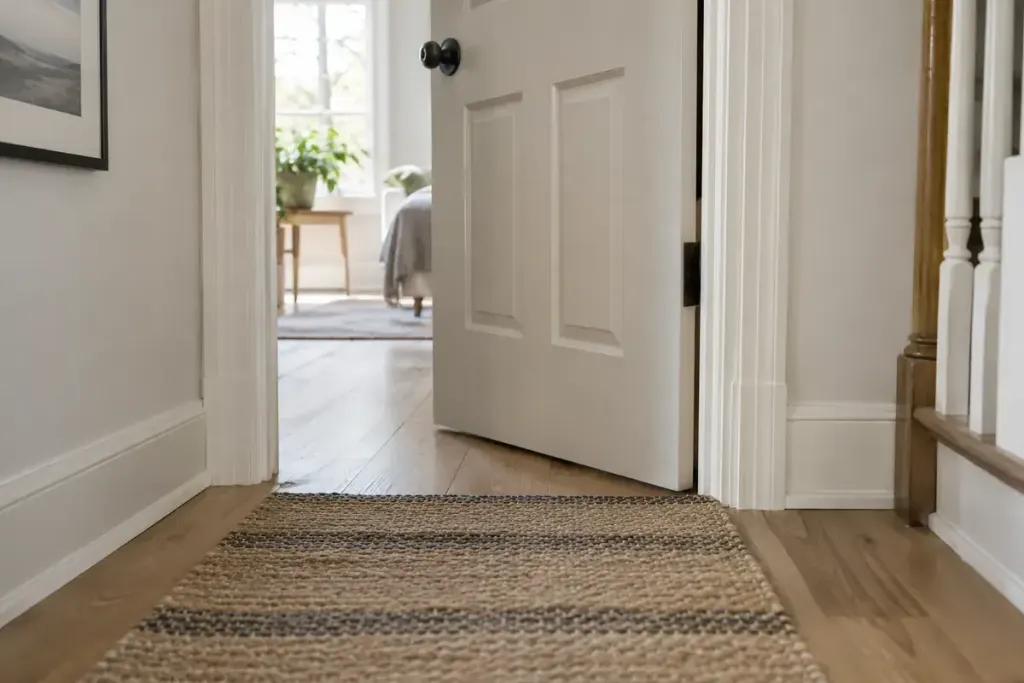
A rug can fit perfectly within a room’s measurements and still prevent the door from opening. The overlooked dimension is height. Pile, backing, underlay, and an uneven floor all contribute to the clearance the door needs.
Open the door through its full normal swing before shopping. Observe where the gap is smallest rather than measuring only at the closed position. If the floor rises slightly along the swing, a rug that fits beneath the first few centimetres may catch farther across the room.
Assess the whole assembly
Use the combined thickness of rug and intended underlay. A product photograph rarely makes that clear. Ask for specifications or a sample and check the return policy if you cannot test the fit before purchase.
Do not assume a soft pile will compress harmlessly every time the door passes. Repeated contact can move the rug, curl an edge, or make the door difficult to use. The result may also be awkward for someone using a wheelchair, walker, or pushchair.
Keep the route clear and stable
Check transitions at thresholds and ensure the chosen backing or underlay is compatible with the flooring. A rug should not slide into the doorway or create an edge that catches a foot. Follow the maker’s cleaning and placement instructions, especially where moisture is likely.
If the rug does not fit, consider a lower-profile option, another position, or leaving that section of floor clear. Do not modify a fire door or other regulated door to accommodate a decorative purchase; consult a qualified professional about any door alteration.
After installation, test the door several times and walk the route in ordinary use. Recheck after cleaning or repositioning, when the underlay may have shifted. A successful entrance rug works with the door and the people using it, not just with the colours in the room.