
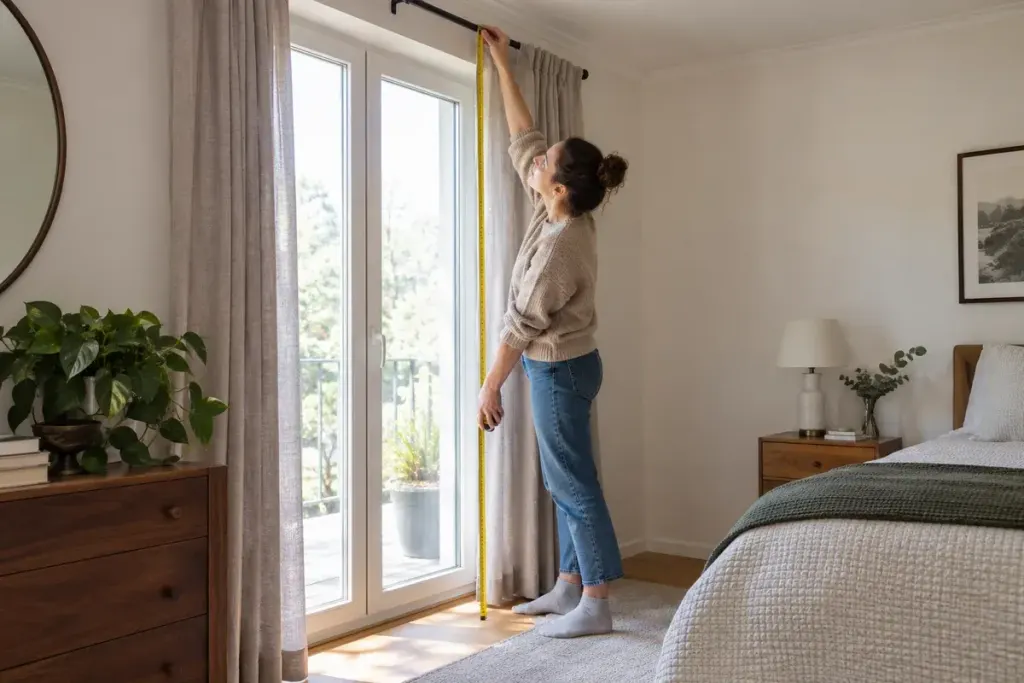
The window is a familiar reference point, but it is not necessarily where your curtain begins. A track, pole, ring or heading changes the relationship between the fitting and the fabric. Decide on the hanging system before placing the curtain order.
Use the supplier’s instructions for the particular heading style. Some measurements begin at a ring or hook position; others use a different reference. Mixing instructions from two systems can produce a confident measurement with the wrong starting point.
Check the fitting and obstacles first
Confirm whether the fitting will be wall-mounted or ceiling-mounted and where it can be installed safely. Look at the window opening, handles, sill, furniture and heating equipment. Curtains must not create an unsafe obstruction or contact with a heat source; follow relevant equipment and installation guidance.
IKEA’s curtain-planning guide illustrates how mounting choice and intended length affect the measurement. Its examples are useful for planning, but your selected system’s instructions determine the exact method.
Measure more than one position
For a floor-length curtain, measure at several points across the proposed span. Floors and fittings are not always perfectly level. Record the raw measurements before deciding what allowance to apply. Do not average away a difference without understanding whether the curtain will drag at one end.
Think about practical use. A softly pooled curtain may suit a photograph but be inconvenient near a busy doorway, pet bed or frequently cleaned floor. A clear floor line may be more useful. The desired finish should follow the room, not just a styling trend.
Keep width and drop separate
The fitting’s width, the fabric’s fullness and the finished drop are different quantities. Confirm whether the seller asks for a total width, panel width or track measurement, and whether hems or heading allowances are already included. Write the units on every note.
Before submitting an order, read the measurements back with the supplier or installer. Include the heading style, mounting position and intended clearance. If the fitting has not yet been installed, identify which numbers are provisional. A short labelled sketch can prevent more confusion than a long message containing several unexplained dimensions.